

Flood Warning Systems for Dams
Sirens for dams safety and flood warning – when there is a risk of flooding, time is of the essence
There are thousands of dams around the world. Rivers are dammed using reservoirs for drinking water supply, for irrigation or for the generation of energy using hydropower. In mining, mining companies create dams or retention basins for water and for the sediments that remain after rinsing the mining product, such as copper, iron ore, gold or silver. This sediment, whether it is liquid, mud or stone, is often toxic or radioactive. Dams like these present a fundamental risk to the population living in their vicinity. Even if they were originally designed to be safe, ageing of the materials, storms, earthquakes as well as human error can cause a dam to burst. When dams burst, masses of water or mud plunge into valleys and civilians are often left with little time to get to safety.
As well as establishing a safe work environment for the miners and dam workers, a strong emphasis also needs to be placed on civil protection. This applies to surface mining as well as to hydropower plants and reservoirs for water supply. This is why sensors are used to monitor the dam structure and trigger a predefined warning and information process in the event of imminent danger. A clear warning needs to be sent out within seconds. And not just directly at the dam itself, but also across the entire area that is at risk of being flooded by the tidal wave or mud slide. Siren warning systems are essential in this context. They are loud and clear. This is why they are not only installed in the mining area, but also along the possible route that the water or the mud may take if a dam breaks or if there is a planned opening of the locks. In addition to raising the alarm in an emergency, they are also used to warn people in case of tidal waves, for example when large amounts of water are specifically drained off.
Siren system requirements for dams
- Alarm signal must be able to reach everyone in the entire danger area
- Tripping in seconds
- Availability must be independent of the power grid
- Every necessary communication infrastructure must be possible
- Integration into national warning systems must be possible

Warning systems for hydro or tailing dams - how sirens protect the public
Siren warning for hydro dams
Sirens are ideal warning systems for dams - easy to integrate into the warning infrastructure, reliable, very low-maintenance and operational for many years. They warn people downstream quickly and unambiguously of the water masses flowing into the valley through controlled release or, in the worst case, through a dam failure. Therefore all over the world, dam operators rely on siren warning systems from HÖRMANN Warnsysteme. Do you have any questions? Please contact us without obligation.
Siren warning for tailing dams
People living below mines are at risk of a tailing dam break. Operators therefore rely on early detection of weak points. However, should a dam burst, employees and the population must be warned quickly. Electronic sirens are ideal for this purpose. Integrated into a warning infrastructure, they provide a quick and clear warning of the danger and can thus save lives.
Components of a siren warning system for reservoirs, dams and retention basins

Control units
The dam is mostly monitored on site. The on-site control centre usually has all the information and is responsible for triggering sirens in a matter of seconds in case of imminent danger. This is primarily the case for private operators of mines or hydropower plants. One control centre is often sufficient, but sometimes there are two. It is not uncommon for government agencies to be given another control centre or to be included in a network with those of the dam operator. In the case of state-owned energy providers who operate several hydropower plants, and also in the case of larger plants, the local control centres are generally supplemented by one or more central control centres which are all connected in one network. Sometimes there are also backup centres. Large infrastructures like these are usually managed via PC-supported control centres and CCCS operating software. Siren warning systems for dams are usually small to medium-sized siren networks with the MCE gateway as a standard component in the control unit, supplemented by a remote control panel or external solutions for triggering. In this instance too, the communication structure is designed so that the alarm can be raised within a very short time. The MCE gateway demonstrates its flexibility here as its scalable hardware and many interfaces enable networked master-slave control centres as well as individual, also networked, redundant control centres to be established.
Sirens
Dams can feature siren warning systems with just one siren all the way up to siren networks with several hundred sirens. But this is the exception. Usually warning systems comprise up to 25 sirens. These often need to be installed several kilometres away from the dam. Our experts determine the optimum siren locations using sound propagation analyses and the required siren output for the relevant site. Communication options and a guarantee of the power supply also need to be taken into account. Electronic sirens such as the ECN-D can be optionally operated by local solar panels and are therefore separate from the power grid. However, they are still able to maintain the alarm signal at the same output for at least 30 minutes. They are also able to output voice texts and announcements and therefore also have an information function in addition to their warning function.


Communication
Communication between the control centres and the sirens needs to be flexible because when it comes to dams, the infrastructures can differ vastly from one case to another. The control units usually communicate with the sirens wirelessly, but our sirens are also linked via Modbus RTU or other communication channels. The MCE gateway provides the required communication flexibility thanks to its flexible interfaces and wide-ranging support for standard communication protocols, whether this is to the sirens, between control centres or via I/O interfaces with solutions from third-party providers. By developing our own hardware and software, we are able to react to every need and establish appropriate concepts.

Warning System for Cities and Municipalities
Civil protection in cities – sirens provide a quick warning in the event of a disaster
In Germany, warning the population in the event of disasters and other dangers is a state issue. The federal government is only responsible for civil protection in matters of defence. Around 80,000 sirens were in use up to the end of the Cold War. Back then, there was still a national siren network. These sirens were largely dismantled at the start of the 1990s for cost reasons. Germany has not had a nationwide siren network ever since. Only municipalities that took over the costs for the network kept their sirens. In Austria too, many cities and municipalities operate their own siren networks.
The higher incidence of natural disasters, such as floods or hurricanes, as well as major fires or toxic substances in the air, which has made systems for alerting civilians necessary, has triggered a change in approach. Cities and municipalities, supported by their respective countries, have been constructing siren networks over recent years. Sirens are an essential part of a civil protection concept when you need to warn your civilians of an emergency quickly and reliably. They also let you reach people who may not have their radio on or their mobile phone with them or who are not connected to the internet. Sirens that not only warn, but also inform. In addition to siren alarms, sirens in some siren networks can also be used to output voice messages or radio announcements.

Requirements for regional siren warning systems:
- Suitable for warning the public, but also for alerting fire services
- Can be integrated into multi-level siren networks, for example regional or national
- Connection option or flow of information between private warning systems, such as in plants at risk of major incidents, and the city warning systems
- Multi-level control centre infrastructure possible
- Can be integrated into warning concepts such as MoWas (Federal Modular Warning System) and into the analogue or digital BOS radio network of the respective country
- Alternative communication options, e.g. via analogue UHF/VHF radio, DMR, TETRA, VPN, GPRS
- Cost-effective to operate
- Easy to maintain and long-lasting
Individual planning for the optimal urban siren system
Sirens have technically developed in the last few years. Accordingly, it is necessary taking into account all important parameters (sound pressure, building development, ambient noise, site conditions, etc.) to select the right locations where to install the electronic sirens. Our specialists therefore plan each siren system individually and thus find both the optimal locations and the appropriate electronic siren models. In addition to location criteria such as hazards, immission, topographical, meteorological and structural conditions, economic aspects are also taken into account.
In urban warning systems, often there is also a kind of dual use, with some electronic sirens being used specifically to alert the fire department. In addition to a central control center, which monitors and manages the entire siren system, the fire department sirens are often triggered by a simple local control unit at the push of a button. Sometimes loudspeakers can also be integrated in buildings to warn the fire department.
In addition to radio, the activation of the sirens via a dedicated line is also a common method. Communication connections such as VPN or GPRS are also possible. Of course, the individual communication media can also be combined to increase the reliability of a system. The experts at HÖRMANN Warnsysteme were not only involved in the development of the siren network in Germany at that time, but can also draw on the experience of a number of installed mass warning systems in cities and municipalities in Germany and abroad.


Tsunami Warning Systems
Tsunami warning systems – sirens alert reliably and save lives
When a tsunami reaches the coast, it generally causes a major loss of life, devastates the infrastructure and tourists tend to stay away from the region for many years to come. As well as grief and tragedy, the population has to face the immense task of rebuilding an inhabitable environment. This is associated with enormous private and government investment. It is often many years before regions affected by tsunamis are able to resume a relatively normal way of living.
Tsunamis cannot be prevented. Affected regions are under constant threat. Tsunamis are fast – they often hit the coast unexpectedly very soon after an earthquake has been registered in the ocean. Time is of the essence when a tsunami is about to hit. They are at their most destructive when there is not enough time for evacuation and escape.
Tsunami alert systems help to keep the loss of human life as low as possible. They detect impending earthquakes and send out warnings before a tsunami is triggered. No time is wasted. The civilian warning prior to a tsunami is sent out across various media. Sirens are an important aspect of the so-called “last mile”. They do not need to be actively enabled by civilians, work independently of the power supply, the internet or GSM network, and send out high-volume warnings within seconds. A siren can be heard everywhere, even on the beach, in the water, in the most provincial hut or on a boat close to the shore. An expertly designed siren warning system allows individual sirens to be selected and alarms to be triggered in a matter of seconds.
If you want to know why we are the right partner for your tsunami warning system watch this video.

HÖRMANN sirens: Tried and tested in many tsunami alert systems
The requirements for tsunami alert systems are different for every application scenario. This is why our specialists get a detailed picture of the location on the ground.
- They consider particularly critical zones
- The population density
- Evacuation options
- The communication infrastructure and the terrain with regard to the positioning of sirens
The system is only designed after this process. HÖRMANN Warnsysteme can draw on many years of experience in a large number of siren projects implemented worldwide as part of tsunami alert systems.
One example is the Pacific island nation of Vanuatu. In this video published by the United Nations Office for Disaster Risk Reduction (click here to watch the video), those responsible explain their strategy to be prepared for future tsunamis. HÖRMANN sirens play an important role in this.
Case Study
Tsunami warning sirens for Vanuatu
Components of a siren system to warn of tsunamis

Control units
In tsunami alert systems, sirens are usually integrated into central control centres within warning centres. The MCE (Management Control Equipment) gateway is used as a quick and reliable communication interface between the sirens and control station(s). Sirens are managed and controlled via CCCS software, an RCS control panel or via external solutions. This gives employees in the warning centres a constant overview of siren statuses and enables them to raise the alarm in seconds. Depending on the requirements and size of the siren warning system, the sirens are monitored by one or more control centres. The MCE gateway with its flexible software, scalable hardware and many interfaces allows redundant control centres to be set up, such as master control centres with regional control stations or master control centres with backup centres.
Sirens
Regional or national tsunami alert systems may comprise just a few sirens or several hundred. They are often located in remote regions where maintenance is difficult and the power supply is not reliable. Electronic sirens such as the ECN-D are perfect for these conditions. They can be operated using local solar panels and are therefore independent of the power grid. However, they are still able to maintain the alarm signal at the same output for at least 30 minutes without having to recharge the batteries. Functions such as automatic self-monitoring and the robust design without movable parts make them low-maintenance.


Communication
Communication between the control centres and the sirens needs to be flexible. The requirements are too varied, for example, in a sparsely populated island state compared to a large city by the sea, a mountainous area or a sprawling tourist region. Thanks to its flexible interfaces, the MCE gateway provides the required communication flexibility. In our tsunami alert systems, we have been using Ethernet, satellite communication, analogue or digital radio and GPRS for a long time in line with demand. By developing our own hardware and software, we are able to react to every need and establish appropriate communication channels.

Sirens for Fire Stations
Sirens for fire stations to alert the fire brigade
Electronic sirens are essential for many fire brigades, despite there being digital and analogue radio receivers, SMS, mobile phones and other ways to issue warnings that may seem more modern. They are loud and drown out ambient noise, and what’s more, they are not dependent on the availability of the internet and also work in network dead zones.
The requirements for siren warning systems for fire stations are very unique. For example, there is a big difference between a single electronic siren on the roof of the fire station to alert fire fighters in the area and a siren, which is used for public warning as well as to alert the fire brigade. In this case, fire station sirens are often integrated into a city-wide siren network. The electronic sirens from HÖRMANN Warnsysteme are suitable for all requirements thanks to their performance range and diverse control options. They are compatible with all currently approved siren remote control units and can easily be integrated into existing networks.

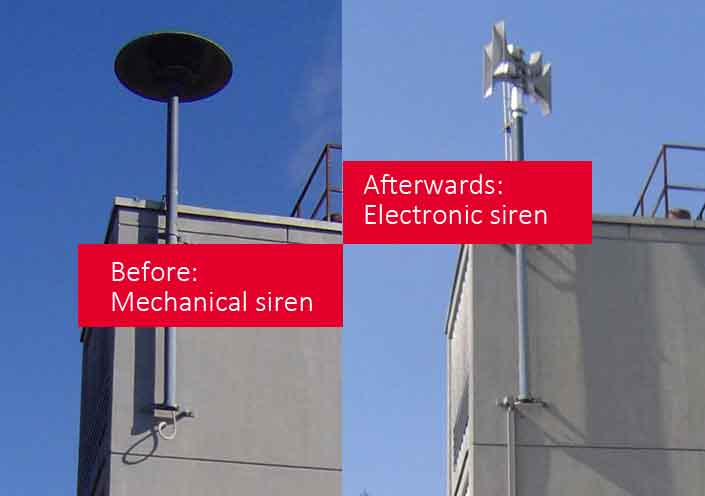
Electronic siren as an economical alternative for a mechanical siren
In rural areas in particular, there are still lots of electromechanical sirens installed as the only siren on fire station roofs. In Germany, these sirens have been used since the end of the Second World War. The E57 was installed in the Federal Republic of Germany, while the DS977 was installed in the former GDR.
These electromechanical sirens having been serving their purpose in many fire services for decades. However, the electromechanical siren has been outdated for a long time. It requires three-phase current and is therefore dependent on a power supply. An emergency power generator is required to maintain operability in the event of a power failure. Replacing the standard siren with a modern model does not require a lot of effort or money.
It is usually very straightforward to replace a single electromechanical siren with an electronic siren. The ECI electronic siren model is recommended as a modern, high-performance alternative to electromechanical sirens. Operation is simple without compromising on performance. The electronic sirens do not require three-phase current and remain operational for up to a month thanks to the integrated battery. The technology is easy to maintain. Many fire services have already replaced their old electromechanical sirens with our modern complete system, including, for example, the Baierbrunn fire service near Munich.

National Siren Warning Systems
Mass warning systems – tailor-made siren warning systems ensure security
National civil protection concepts aim to alert the population in the event of military or terrorist attacks, natural disasters or industrial accidents. Due to climate change, the occurrence of storms, strong winds and floods is on the rise. Earthquakes affect many regions on earth. The political situation is becoming increasingly unstable. This is why many states are choosing to upgrade their infrastructure for alerting their civilians or starting to set up or expand their national warning systems. Disaster protection solutions like these are a complex combination of various surveillance and communication media that are usually monitored and controlled via multi-level control centres.
The purpose of a national warning system is to warn AND inform the population. The warning, also referred to as the alert, makes civilians aware of the imminent risk and should motivate them to turn on media such as the radio, etc. to get more information. Siren networks are an essential and effective way to alert the population quickly as mobile networks do not work everywhere and not everyone will have their mobile phone or a radio switched on. However, modern electronic sirens not only have the ability to warn, they can also inform thanks to their voice announcement function. This allows, for example, clear instructions to be given to civilians. Establishing a national siren network often takes several years and has stringent planning requirements.
Special requirements for national siren networks:
- Risk potential varies from region to region
- No uniform terrain conditions and climate zones
- Highly and less densely populated areas
- Areas that are well or less well connected to the power supply or communication infrastructure
- Multi-level control infrastructures with regional and national centres
- Scalable triggering of individual sirens via defined groups, up to all sirens in the country
- Option to integrate private warning systems, for example, industrial properties, mines or dams
- Can be integrated into national warning concepts, such as the German MoWas (Federal Modular Warning System)
- Cost-effective to operate
- Easy to maintain and long-lasting
HÖRMANN Warnsysteme is the pioneer when it comes to developing and manufacturing electronic sirens. HÖRMANN sirens made in Germany have been a reliable component of national mass warning systems around the world for many years. Our employees are experts in planning cost-effective, reliable and tailor-made siren networks for civil protection. As a manufacturer, we know our products inside out and also develop our own hardware and software. This puts us in the position to implement optimum warning systems anywhere in the world for any requirement together with our competent partners on site, and to maintain them too.

Your advantages:
- Experience from installing over 60,000 sirens
- Trained, competent partners on site
- Global service network
- Development of own hardware and software
- Quality and innovation with “made in Germany” sirens

Why mass warning and notification systems still need sirens
Outdoor warning sirens are an indispensable part of a mass warning system - despite modern communication technologies. Why this is the case is explained in this article published in IFF magazine.

Risk Management
Integration and central management of all security systems
The ability to identify risks, assess their potential impact and then take appropriate action is key to professional risk management. This is why in a security control centre, all information from individual security systems, such as intruder alarm systems, fire alarm systems, access control systems and video surveillance, converges and is displayed in a central location. For example, live images from surveillance cameras can be linked to the intruder alarm system. This is essential for efficient risk management that detects break-in and sabotage attempts quickly in order to prevent damage. A well-planned risk management system needs to provide an informative picture of the current situation in simple terms so that action can be taken quickly.
We have been designing and installing customised risk management systems based on the building management system GEMOS for many years. This solution stands out due to its modular design and the variety of available interfaces. This means that security systems from different manufacturers can be managed centrally without any difficulties.
Our services:
- Design of integrated risk management solutions
- Integration of existing security systems into the central monitoring concept
- Installation of security control centres for building management
- Maintenance and support


Video Surveillance
Cameras as preventive security measures
Video surveillance is an essential component of professional risk management. Visible surveillance cameras deter potential intruders. In conjunction with intruder detection systems, they record suspicious movements and help to track intrusion attempts and identify suspects. Video surveillance systems also support access control.
Video cameras can be installed outdoors, for example on fence systems or access roads, as well as inside the company premises. During planning, we make sure that the surveillance cameras cannot be easily dismantled, manipulated or covered. Depending on the requirements, the video cameras can be installed discreetly or visibly and communicate with the control centre of the video surveillance system by radio or via cable. As specialists in security technology, we configure customised solutions that meet the manipulation security requirements of the surveillance cameras or the entire video surveillance system and are GDPR-compliant. In combination with other security components, we can create a security-optimised surveillance environment tailored to the individual requirements of a company.
Our services:
- Planning, project management, installation, servicing and maintenance of the complete video surveillance system including location planning for surveillance cameras and design of the communication infrastructure
- Integration of video surveillance into a risk management concept
- Certified Geutebrück partner


Access Control
Purposefully protect sensitive areas of your company
Access control systems are a form of preventive security technology. They not only protect people in the building, but also safeguard valuable business assets against industrial espionage or sabotage. The requirements are therefore multifaceted as different groups of people generally have different access rights and some areas may require special protection against unauthorised entry. In addition to this, escape routes still need to be accessible and passable in an emergency.
Our experts in security technology can draw on many years of experience in planning, installing and configuring access control systems. Every system is unique. We have a constant eye on the market and technical developments and this puts us in an excellent position to create the optimum system to meet your needs.
Our specialists in security technology in the field of access control work with products from well-established manufacturers such as Telenot, Honeywell and Maniagao & Henss.
Our services:
- Planning, project management, installation, servicing and maintenance of an access concept using the “who, when, where” approach
- Integration of escape routes and fire doors into the concept
- Selection of compatible system components
- Installation and configuration of access control systems


Fire Alarm Systems
Prompt alarms protect people and assets
Fire poses a major risk to people, assets and buildings. Fire alarm systems are used for fire prevention. The obligation to install a fire alarm system is written into building law. It can also be requested by a building inspector or insurance company. Fire alarm systems perform the following tasks:
- Discovering fires that are just starting
- Sending fire alarms to a permanently staffed location (control centre / fire department)
- Triggering alarms to evacuate buildings
- Activating fire control systems for lifts, extinguishing systems and smoke and heat extraction systems
Systems like these are an essential component of a fire protection concept and need to be planned specifically to meet the needs of the building in question. Future viability, easy adaptability to future extensions and low life cycle and maintenance costs also need to be considered.
We build fire alarm systems in accordance with building regulations as per DIN 14675 and, if applicable, insurance guidelines (VdS) in close consultation with our customers. We examine all the special features of the building that requires protection. With over 50 years of experience in the field of fire alarm systems, we are a trustworthy partner that you can rely on in every respect – in both straightforward environments and more challenging ones involving dust and fumes.
Fire alarm systems installed by us are used in the following applications areas:
- Industrial plants
- Banks
- Warehouses
- Office buildings
- Small businesses and individual office

Our services:
- Analysis of the scope of protection for individual zones (full protection, partial protection, protection of escape routes)
- Planning protection and alarm zones
- Location planning for smoke alarms and product selection
- Definition of alarm zones
- Creation of alarm plans
- Design and programming of the fire alarm system control centre
- Installation and maintenance of the entire fire alarm system
Our specialists in security technology have been working with products from renowned manufacturers ESSER and Detectomat for years.

Intruder Alarm Systems
Prevention and damage limitation in the event of a burglary
Intruder alarm systems are used to protect property and people. They perform several important tasks:
- Deter potential intruders and thus act as a means of prevention
- Notify appropriate services in an emergency
- Minimise the action time of intruders
- Alert anyone in the immediate vicinity
- Help with the reconstruction of the burglary or robbery
Due to differing risk potentials and diverse conditions, intrusion alarm systems are rarely out-of-the-box solutions. This is why our experts design individual intruder alarm systems based on standard components that comply with insurance guidelines (VdS – German Loss Prevention Council) and the requirements of the state police offices. The system components we use satisfy the most stringent quality and service requirements, ensuring high availability of the intruder alarm system. Particularly sensitive areas can be specifically equipped with alarm technology that can be activated separately, for example to meet demanding insurance arrangements.
We work with products from manufacturers such as TELENOT, Honeywell and DAITEM, which stand out due to their high security standard, modular design, modern technology and high level of flexibility.
Intruder alarm systems designed and installed by us are used in the following application areas:
- Industrial plants
- Energy providers
- Banks
- Warehouses
- Office buildings
- Small businesses and individual offices
- Residential homes

Sample configuration of an intruder alarm system
